

Earlier than most Parents think !
One of the most common questions parents ask is simple, but important: When should we start talking seriously about careers?
There is often hesitation around this. Many parents worry that starting too early might create unnecessary pressure or force children into decisions they are not ready to make. Others assume that clarity will emerge naturally with age and prefer to wait until Class 10 or later.
In practice, what I have observed over two decades of working with students and families is quite consistent. The issue is rarely that conversations begin too early. It is that they begin too late, often at a point where decisions feel urgent and options seem limited.
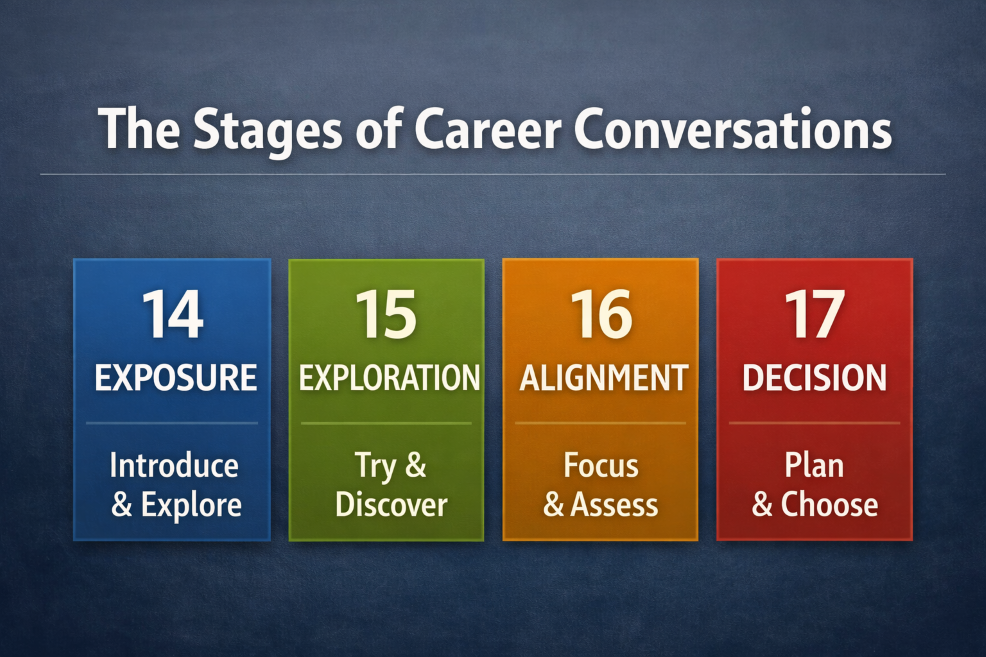
Career conversations are not a one-time discussion. They are a process that evolves over several years.
At the early teenage stage, the goal is not to identify a fixed career path. Instead, the focus should be on building awareness. This includes helping students notice patterns in their own behaviour, preferences, and responses to different experiences.

For example, a 14-year-old does not need to decide on a profession. But they can begin to recognise which subjects or activities feel energising, which environments they enjoy, and what kind of challenges they naturally gravitate towards. This awareness develops through simple, everyday observations.
Some students feel energised when they are solving structured problems, such as mathematics or coding tasks. Others come alive in open-ended situations like writing, designing, or debating. Some prefer working independently, while others thrive in collaborative environments where ideas are exchanged.
Even outside academics, these signals appear clearly. A child who voluntarily spends time researching a topic, building something, creating content, or engaging in discussions is offering valuable insight into their natural inclinations. These patterns are far more reliable indicators of future fit than a single exam score or a one-time achievement.
Equally important is noticing what drains energy. A student may perform well in a subject but consistently avoid engaging with it beyond what is required. That distinction between performance and genuine interest becomes critical over time.
When parents begin to observe these patterns early, conversations become easier and more meaningful. Instead of asking for definitive answers, they can ask reflective questions:
- What did you enjoy learning this week?
- Which activity felt most interesting or engaging?
- What kind of work would you like to explore more?
These questions shift the focus from decision-making to discovery.
As students move into higher classes, this awareness begins to shape more structured choices. Subject selection, extracurricular involvement, and skill-building activities start to align with emerging interests. Because the foundation has been built gradually, decisions feel less forced and more informed.
It is also important to recognise that the tone of these conversations matters as much as the timing. Teenagers respond far better when they feel they are being understood rather than evaluated. When discussions are framed around curiosity instead of outcomes, they are more likely to engage honestly.
Starting early is not about accelerating decisions. It is about creating enough space for clarity to develop naturally.
In contrast, when conversations are delayed, families often find themselves compressing years of exploration into a short period. This can lead to stress, rushed choices, and a tendency to fall back on familiar or “safe” options rather than well-considered ones.

Over the years, I have seen that families who begin this process earlier tend to experience calmer discussions, more confident decisions, and better alignment between the student’s strengths and their chosen path.
At MindScan, we have worked extensively with teenagers at different stages of this journey, helping them understand their strengths, explore options, and make informed decisions. If you would like to approach this process in a more structured and thoughtful way, you are welcome to connect with us.
