
Every year, thousands of international students apply to universities in the United States. Some get in. Many don’t. And here’s the part that’s hard to hear: a lot of the rejections have nothing to do with grades or talent. They happen because of avoidable mistakes made during the application process.
I’ve worked with students from across the world for years. Smart, hardworking students who lost good opportunities simply because they didn’t know what the process actually required. This article is about fixing that.
Let’s go through the ten most common mistakes, one by one.
1. Thinking grades are enough
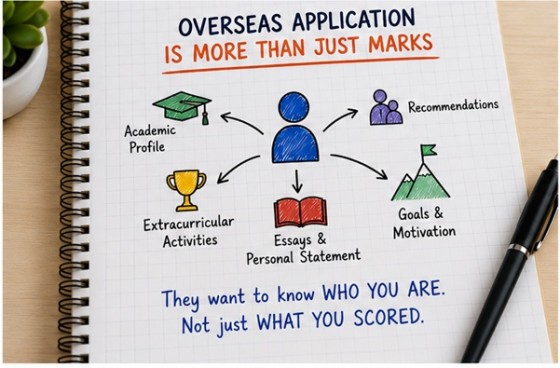
This one catches a lot of Indian students off guard. You’ve spent years working towards 90 – 95 %, and it makes sense to assume that strong marks will carry the application. But US universities don’t work that way.
Most colleges in the US follow what’s called a “holistic admissions” process. According to a survey by NACAC (the National Association for College Admission Counseling), over 56% of colleges place considerable or moderate importance on essays, and around 44% give real weight to activities outside the classroom. Grades matter, yes. But they’re only one part of what’s being evaluated.
What universities are actually asking is: Who is this student beyond the marks?
A student with a slightly lower percentage but a clear sense of self, genuine interests, and strong writing can, and often does, get in ahead of someone with a better academic record but a flat application.
What you can do: Think of your application as a story, not a scorecard. Academics are the foundation, but personality, curiosity, and initiative are what make the story interesting.

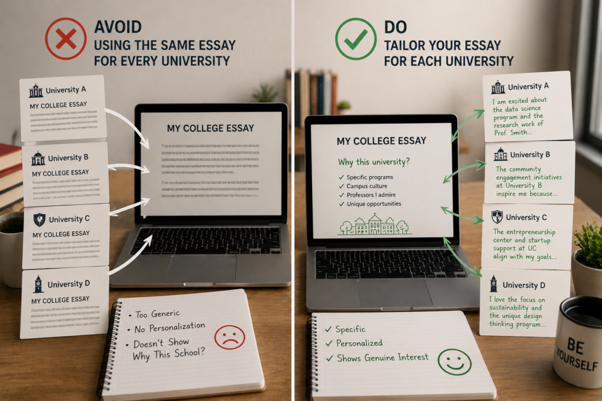
2. Using the same essay for every University
This is one of the most common shortcuts students take, and admissions officers notice it immediately.
The Common Application, which is the platform used to apply to over 1,000 US universities, includes a personal essay that goes to every school on your list. That part is the same. But most universities also ask for additional shorter essays called Supplementary Essays. These are specific to each college. One school might ask why you want to study there. Another might ask about a challenge you’ve faced. A third might ask about a community you belong to.
Students often write one general response and paste it across all supplements with minor changes. The result is an essay that fits nowhere particularly well.
What you can do: Research each university before you write for them. What programs do they offer in your area of interest? What is the campus culture like? What specific clubs, professors, or opportunities excite you? Mention these things in your supplement. It takes more time. It also makes a real difference.
3. Writing essays that don’t sound like you
There’s a very specific kind of essay that admissions officers dread. It uses complicated vocabulary, talks about “transformative journeys” and “paradigm shifts,” and sounds like it was written by someone trying very hard to impress.
It doesn’t impress. It reads as fake.
Here’s the thing: admissions officers read thousands of essays every application season. They can tell, usually within a few sentences, whether a student is writing honestly or performing. Essays that try too hard to sound impressive often say very little about the actual person.
The best essays are specific and honest. They talk about a real moment, a real feeling, a real choice. Simple language, when it carries something genuine, is always more powerful than polished language that says nothing.
What you can do: Write like you speak. Tell a specific story. It doesn’t need to be dramatic. What it needs to be is true and revealing of how you think.
4. Piling-up activities without real commitment
Many students believe that a longer list of activities makes a stronger application. So, they join ten clubs, sign up for five competitions, and list every workshop they’ve ever attended.
This approach tends to backfire.
The Common Application gives you space to list a maximum of ten activities. But more importantly, admissions officers aren’t counting entries. They’re looking for depth. They want to see commitment over time, growth in a role, and genuine involvement. A student who spent three years building something meaningful, whether that’s a school magazine, a sports team, a community project, or a coding hobby, will stand out far more than a student with a scattered list of brief involvements.
What you can do: Focus on a few things that genuinely matter to you. The question to ask isn’t “Will this look good on my application?” It’s “Have I actually invested myself in this?” Real investment shows.
5. Missing deadlines
It sounds obvious. It happens every year.
Managing a US application is genuinely complicated. You’re handling school exams, SAT or ACT preparation, recommendation letters, financial forms, and multiple application portals, often all at the same time. Things pile up. Deadlines slip.
Some students submit minutes before a deadline and face a technical error. Others miss scholarship deadlines entirely because they were focused only on the admissions deadline, not realizing the two are often different.
What you can do: Build a proper calendar from the start. List every deadline you’re working towards: application deadlines (Early Decision, Early Action, and Regular Decision are different), scholarship deadlines, test registration dates, and the dates by which you need recommendation letters from your teachers. Start earlier than you think you need to. A well-organised application is almost always a better application.
6. Not thinking about the complete cost
Here’s a number that surprises most families: the total annual cost of attending a private university in the US, including tuition, housing, food, health insurance, and other expenses, can range from $60,000 to nearly $100,000 per year. According to US News data for 2025-26, the average tuition alone at a private four-year college is around $45,000 per year. Add living costs on top of that, and you’re looking at a significant financial commitment.
Many families focus entirely on getting admission, and only start thinking about cost after the offer arrives. That’s the wrong order.
It’s also important to know that not all universities offer financial aid to international students. Those that do can be genuinely generous. Harvard, for example, reported that students receiving need-based aid paid an average of around $15,000 per year in 2025-26, after grants. But you have to research this before you apply, not after.
What you can do: Look up the full cost of attendance for every university on your list. Then look at whether they offer financial aid to international students and what that aid typically looks like. Build a shortlist that includes financially realistic options alongside aspirational ones.
7. Asking the wrong Teachers for LOR’s
Many students approach the senior most teacher or the one who teaches the most important subject, or maybe the one who gave them the highest marks, for a recommendation. That seems logical. But it often produces a weak letter.
US universities already have your grades in your transcript. The recommendation letter is meant to show something your transcript cannot: what you’re like as a person in the classroom, how you handle difficulty, whether you’re curious and engaged, how you treat others.
A teacher who has seen you grow over time, ask thoughtful questions, help a classmate, or push through a tough assignment can write something that genuinely adds to your application. A teacher who only knows your marks cannot.
According to NACAC data, around 51% of colleges consider teacher recommendations to be of considerable or moderate importance in their admissions decisions.
What you can do: Choose teachers who actually know you. Give them time, ideally at least six to eight weeks before the deadline. Help them by sharing your activity list, what you plan to study, and why. The more context you give, the more specific and useful their letter can be.

8. Hiding weaknesses instead of explaining them
If there’s a dip in your grades, a gap in your activities, or a subject where your performance dropped significantly, the worst thing you can do is hope no one notices.
Admissions officers read entire applications carefully. If something looks inconsistent and there’s no explanation, they fill in the gap themselves. That’s rarely to your advantage.
Maybe you went through a difficult year at home. Maybe you changed schools and needed time to adjust. Maybe online learning during the pandemic affected you in ways that showed up in your results. These are real things that happen to real students, and universities understand that.
What you can do: If something needs context, provide it. There’s a section in the Common Application called “Additional Information” that is designed exactly for this purpose. Keep the explanation brief and honest. Focus on what you learned or how you responded. The goal isn’t to make excuses. It’s to give the admissions reader the full picture so they can evaluate you fairly.
9. AI Written essays
AI tools are genuinely useful. Using them to brainstorm ideas, improve grammar, or check clarity is completely reasonable. The problem begins when a student allows AI to write the entire essay or personal statement.
As of 2024, surveys suggest that around 40% of four-year colleges were already using AI detection tools as part of their admissions review, with another 35% planning to adopt them. Beyond the detection question, experienced admissions officers can often recognise AI-written essays simply by reading them. They tend to be polished but empty: grammatically clean, structurally correct, and emotionally flat.
More importantly, even the best AI cannot accurately invent your specific experiences. It doesn’t know the conversation you had with your father that changed how you think, or the moment during a competition when something clicked. Those details are what make a great essay. Those are the things that make an admissions officer remember you.
What you can do: Write your own first draft, however rough. Include your actual thoughts and memories. Then use AI tools to help you improve the structure or clarity if you need to. The essay should sound like you, because at its core, it needs to be about you.10. Applying to Universities Based on Rankings Alone
This is perhaps the most important mistake on this list.
It’s very easy to build a college list based on rankings, social media videos, or where friends are applying. University rankings can be a useful starting point, but they’re a poor basis for a final decision.
A university ranked in the top 20 might have very large lecture classes, limited support for international students, an intensely competitive culture, and be located in a small town with few internship opportunities in your field. A university ranked 60th might offer small classes, excellent career support, generous scholarships for international students, and a community where you’d genuinely thrive.
The question isn’t which university has a better rank. The question is: which university is the right environment for this particular student?
What you can do:Before you finalise your list, research each university properly. Look at class sizes, what graduates are actually doing after finishing, how strong the specific programme is in your field of interest, what the campus culture is like, and what support exists for international students. Visit virtually if you can. Talk to current students. The university that fits you well will almost always serve you better than a prestigious name that doesn’t.

A Final Word
The US application process can feel overwhelming, especially when you’re coming from a system built around exams and grades, where the path to university is more straightforward. But the key insight is simple: US universities are trying to understand who you are, not just what you’ve scored.
Strong applications have three things in common: they’re honest, they’re specific, and they’re consistent across every section. You don’t need a perfect profile. You need a real one.
Most of the mistakes in this article are avoidable. Knowing about them early gives you a head start.
MindScan Education provides personalised overseas university admissions guidance to students and families. If you’re thinking about applying to the best universities in the world, we’ll be happy to partner you on this journey. Connect with us today !
The information in this article is for general guidance only. Always verify specific requirements and deadlines directly with the universities you are applying to, as policies and costs can change.