

7 Reasons You Should Research Every College Before Applying
Applying to college has become more competitive than ever.
Students spend months improving their grades, preparing for standardised tests, participating in extracurricular activities and writing application essays. Parents spend countless hours discussing options, attending webinars and trying to understand university rankings.
Yet, one of the most important parts of the entire process often receives the least attention: researching the colleges themselves.
Many students create a list based on rankings, recommendations from friends, or social media posts. Some choose universities simply because a senior from their school was accepted there. Others apply because they’ve heard the name before.
The problem is that getting into a university and choosing the right university are two very different things.
A college isn’t just a place where you’ll earn a degree. It will shape the people you meet, the opportunities you receive, the experiences you have, and often, the direction your career takes.
That’s why researching every college before you apply isn’t optional. It’s one of the smartest investments you can make.
1. Every college has its own personality
It’s easy to assume that universities offering the same course are largely similar. In reality, they can feel completely different.
Some universities are known for rigorous academics and independent learning. Others encourage collaboration, project-based learning and close interaction with professors. Some campuses are buzzing with student activities throughout the year, while others are quieter and more research focused.
Imagine two students studying Computer Science. One thrives in an environment where professors challenge students to conduct research from the first year. The other prefers practical projects, internships and industry collaborations. Both students may be studying the same subject, but each will flourish in a very different environment.
This is why it’s important to look beyond the course title. Explore the university website, watch student videos, read campus publications and speak to current students whenever possible. The more you understand the culture of a university, the easier it becomes to judge whether you’ll genuinely enjoy studying there.
Finding the right fit often matters far more than finding the highest-ranked institution.
2. The best course isn’t always at the highest-ranked university
One of the biggest mistakes families make is focusing entirely on overall university rankings. Rankings are useful, but they don’t tell the complete story.
A university that ranks 25th globally isn’t automatically the best choice for every subject, and more importantly , may not be the best university for you.
Instead of just asking and focussing on, “How good is this university?”, ask, “How good is this university for me?”
Additionally, for some courses like Hospitality Management ,Design, Animation or Agriculture, some universities that don’t feature prominently in overall rankings may actually be among the world’s best for those specific disciplines.
Look at the curriculum. What subjects are taught? Does the course include internships? Are students encouraged to undertake research? What kind of facilities are available? How experienced are the faculty members?
These questions provide far more useful information than a ranking alone.
3. The location can influence your future career
Where you study matters almost as much as what you study.
A university located in the heart of a thriving business or technology hub naturally provides different opportunities compared to one situated in a small college town.
Students interested in finance may benefit from studying close to major financial centres. Someone pursuing film or media could gain valuable exposure by studying in cities with strong creative industries. Engineering students often find better internship opportunities near manufacturing or technology clusters.
Location also affects everyday life.
Climate, public transport, safety, living costs, cultural diversity and part-time work opportunities all influence your overall university experience.
A university may look impressive on paper, but if its location doesn’t support your academic and career goals, it may not be the right choice.
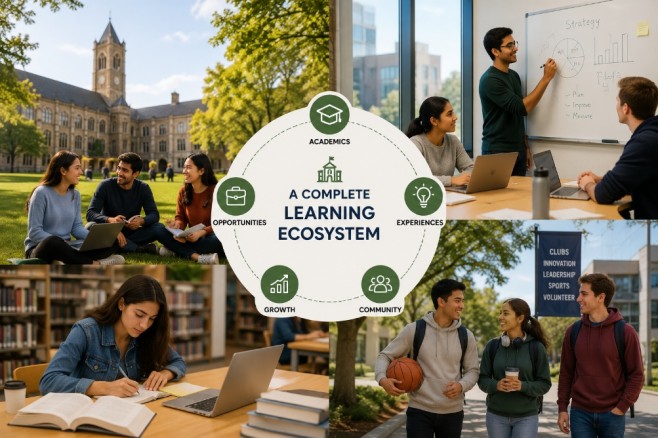
The best universities don’t just provide classrooms. They provide an ecosystem where students can learn both inside and outside campus.
4. Career outcomes tell an important story
Every university promises an excellent education.
What really matters is what happens after graduation.
Before applying, spend some time understanding the career outcomes of recent graduates. Where do they work? Which companies recruit from the university? What percentage of graduates find employment within six months? How many pursue postgraduate education? Are alumni working in leadership positions across different industries?
These aren’t just statistics. They tell you whether the university consistently prepares students for the future.
Many universities publish graduate outcome reports every year. Others highlight employer partnerships, internship programmes and alumni success stories. These resources often reveal far more about a university than marketing brochures ever can.
Remember, your degree is only one part of your journey. The opportunities available after graduation are equally important.
5. Scholarships and costs vary much more than most families realise
Many parents assume scholarships work in a similar way across universities.
They don’t.
Some universities offer generous merit scholarships that automatically consider every applicant. Others require separate applications with different deadlines. Some primarily support students based on financial need, while others provide very limited funding for international students.
The total cost of studying also extends well beyond tuition fees.
Accommodation, meals, health insurance, transport, books and personal expenses can vary significantly depending on the university and the city.
Two universities may charge similar tuition fees, but the overall cost of studying at one could be considerably higher simply because of where it’s located.
Researching these details early allows families to create a realistic financial plan and avoids unpleasant surprises after receiving an offer.
6. Student life plays a bigger role than you might expect
Students don’t spend every hour inside a classroom. For three or four years, the university becomes their home. This makes campus life an important consideration.
Look beyond the academic brochure and explore what everyday life actually looks like. Are there clubs and societies that match your interests? What sports and recreational facilities are available? Is accommodation easily accessible? How strong are the support services for international students? Does the university encourage volunteering, entrepreneurship or student leadership?
These experiences often shape confidence, friendships and personal growth just as much as academic learning.
Parents sometimes focus only on the degree, while students focus only on campus life.
The right university successfully combines both.
7. Good research leads to stronger applications
Research doesn’t just help you choose where to apply. It also helps you submit a much stronger application. Admissions officers can usually tell when an applicant has genuinely taken the time to understand their university.
Instead of writing generic statements like, “Your university has an excellent reputation,” students who have done their homework can explain why a particular module, professor, research centre or internship opportunity excites them.
That level of detail demonstrates genuine interest.
It shows the admissions committee that the student hasn’t randomly selected another university to add to a long list of applications. They’ve carefully considered why that institution aligns with their goals.
Ironically, spending more time researching often means applying to fewer universities, but with much stronger applications.
Final Thoughts
A successful college application isn’t about submitting the largest number of applications. It’s about identifying the universities where you’ll thrive academically, personally and professionally.
The time you spend researching today could influence the next four years of your life and perhaps the next forty years of your career. So before you click “Apply”, pause for a moment.
Ask yourself a simple question:
Do I really know enough about this university to believe it’s the right place for me?
If the answer is no, spend a little more time researching.
It may turn out to be the most valuable part of your entire application journey.
At MindScan, we work with students & handhold them through the entire process of university research and application. If you’re thinking about applying to the best universities in the world, we’ll be happy to partner you on this journey. Connect with us today !