

AI can tell you about thousands of careers and universities. But can it help you decide what’s right for your child?
A Class 10 student is trying to decide between Science and Commerce. A parent is researching universities in the UK and Canada. Another family is debating whether an expensive overseas undergraduate degree is worth the investment.
Increasingly, all three are turning to the same place for answers: ChatGPT.
And why not? Ask a question and, within seconds, you have a list of courses, colleges, entrance examinations, career options and even a suggested roadmap for the next five years. For students and parents navigating the rather complicated world of higher education, this can feel like having a counsellor available around the clock. As someone who has worked with students and families on career and higher education decisions for many years, I find AI tools genuinely useful. They have changed the way students research and access information. However, I also believe we need to be careful about the role we allow them to play in decisions that can shape a young person’s future.
My answer to the question is simple: Yes, use ChatGPT to explore possibilities and organise your thinking. But don’t use it as the final authority on a decision that is deeply personal. The biggest limitation of AI in career and higher education planning is something quite fundamental: it doesn’t really know the child or the family.
Let’s look at what this means for both students and parents.

For students: A great place to start exploring
One of the biggest advantages of ChatGPT is that it makes information accessible. If you enjoy Biology but aren’t particularly keen on becoming a doctor, you can ask about biotechnology, genetics, neuroscience, food science or environmental biology. If Economics interests you, you can explore careers in public policy, behavioural economics, financial analytics and development research.
You can also use it to:
- Understand the difference between undergraduate courses that sound similar.
- Identify universities offering specific programmes.
- Explore entrance examinations and admission requirements.
- Compare studying in India with studying overseas.
- Understand the skills and academic qualifications required for different careers.
- Prepare questions before speaking to a teacher, counsellor or university representative.
For a teenager who is looking for information, this is useful. It can introduce possibilities that may not be discussed at home or in school. But if you’re still discovering your interests, using AI can be disastrous.. and that’s exactly the catch.
ChatGPT doesn’t know whether you enjoy working independently or in a team. It doesn’t know whether you are comfortable with uncertainty, how you have performed academically over the years, or whether a particular subject genuinely interests you or simply happens to be your strongest subject. It doesn’t know your temperament, your learning preferences or how you respond when faced with academic pressure.
Two students with identical Class 10 marks and the same subject preferences could be very different individuals. One might thrive in a highly competitive academic environment, while another might do better in a more flexible setting.
The right advice for one may be quite unsuitable for the other. So, use AI to expand your thinking, not to outsource it.
For parents: Information is not the same as understanding
Parents approach higher education planning with a different set of concerns: Is this course employable? Is the university worth the investment? Should we consider India or overseas? Will our child be able to manage independently? What happens if they change their mind halfway through?
ChatGPT can help answer many of these questions. It can compare universities, explain admission processes, outline approximate costs and help families understand the advantages and disadvantages of different destinations.
But it cannot understand the complete family context.

It doesn’t know your financial comfort level, whether you have other children whose education needs to be funded, or whether your child has family responsibilities. It may not be able to factor in interest in sports, or MUN’s of painting and whether studying far from home is practically and emotionally feasible. It may recommend an excellent university overseas without understanding that the financial commitment would put considerable pressure on the family. It may suggest a demanding academic pathway without knowing the student’s temperament or academic history.
There are also regional and practical considerations. A student’s access to certain subjects, coaching, extracurricular opportunities or language support may depend on where they live and the school they attend. These factors can influence which pathways are genuinely accessible. Then there are the unspoken expectations within a household. Sometimes a parent wants the security of a conventional profession, while the teenager wants to explore something less familiar. Sometimes the student is keen to go abroad, but the family is hesitant for reasons that have little to do with finances.
Knowing thousands of career options is one thing. Understanding which of those options would suit a particular child, given their abilities, temperament, aspirations and family circumstances, is quite another.
These are conversations that require understanding, sensitivity and experience. A chatbot cannot reliably read what hasn’t been shared with it.
Where ChatGPT can get things wrong
There is another important consideration: accuracy.
University admission requirements, entrance examination patterns, eligibility criteria, tuition fees and scholarship policies change regularly. An answer that was correct last year may no longer be valid.
This is particularly relevant in India, where admission requirements can vary considerably across universities and programmes. Whether it is CUET, JEE, NEET, CLAT or institution-specific examinations, students should always verify information through official sources.
The same applies to overseas admissions. Course structures, subject prerequisites, standardised testing requirements, application deadlines and scholarship policies need to be checked on university websites.
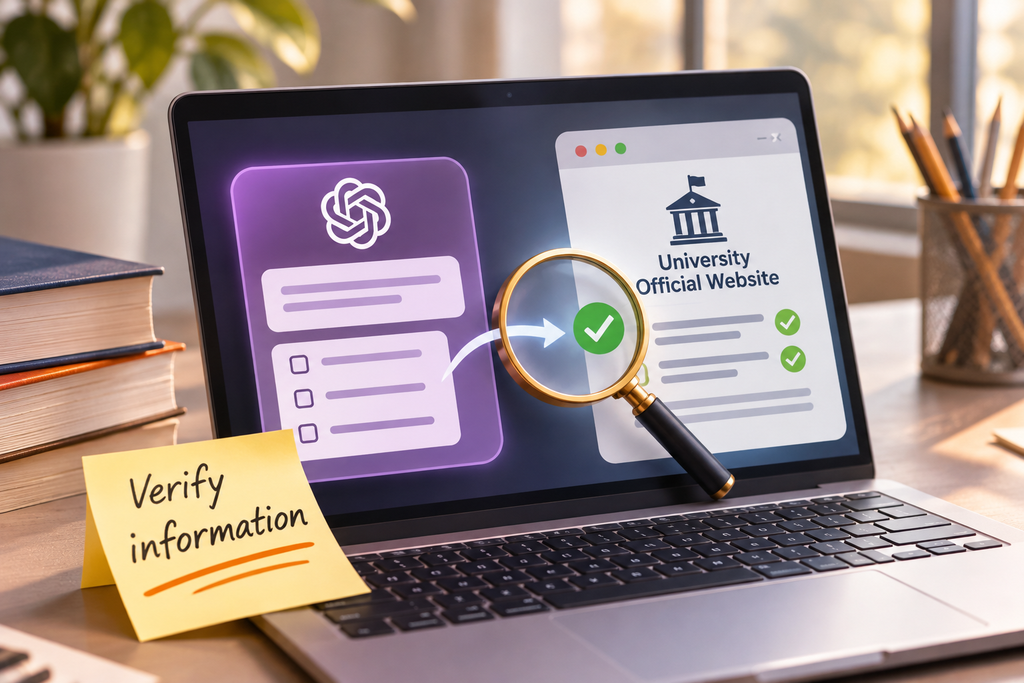
There is also the danger of over-reliance. A student may receive a convincing answer and assume it must be correct. But a well-written answer isn’t necessarily an accurate one, and a detailed career recommendation isn’t necessarily a suitable one.
AI can also reinforce the assumptions in a question. If a student asks which engineering specialisation is best because everyone at home expects them to become an engineer, the response may focus on comparing engineering options rather than questioning whether engineering is the right direction in the first place.
Sometimes, the most important question is the one that hasn’t been asked.
So, where does a career counsellor fit in?
I believe the two can complement each other.
AI is excellent at organising information, comparing options and helping students understand unfamiliar subjects. A good career counsellor brings something different: the ability to understand the individual behind the question.
Through conversations, academic history, psychometric assessments and discussions with parents, a counsellor can help connect a student’s interests, abilities, temperament and circumstances with realistic educational possibilities.
For example, when a student is deciding between Science and Commerce after Class 10, the discussion shouldn’t begin and end with marks or perceived career opportunities.
It should explore what the student enjoys learning, how they approach problems, what motivates them and which subjects they are willing to engage with over the next two years.
Similarly, when considering an undergraduate degree overseas, the discussion needs to go beyond university rankings. The course structure, teaching environment, academic expectations, career ecosystem, costs and the student’s readiness to live independently all matter.
Just as importantly, a counsellor can challenge assumptions. Sometimes the best outcome of a counselling session isn’t a recommendation. It’s helping a student or parent look at a familiar situation differently.

Experience matters too. Having worked with thousands of students and families, I have seen how two seemingly similar profiles can lead to very different decisions. There is no universal formula for choosing the right stream, course or university.
How students and parents can use AI more effectively
Rather than avoiding ChatGPT, I would encourage families to use it more thoughtfully.
Here are a few practical suggestions:
1. Ask questions that broaden your choices.
Instead of asking, “Which is the best career after Class 12?”, try asking, “I enjoy Biology and Chemistry but am not interested in becoming a doctor. What undergraduate pathways could I explore?”
2. Use it to understand, not just to shortlist.
Ask it to explain the differences between courses, the subjects required, the nature of the work involved and the skills you would need to develop.
3. Verify important information.
Always cross-check admission criteria, eligibility, examination requirements, fees and deadlines through official university and examination websites.
4. Discuss the answers as a family.
Use AI-generated information as a starting point for conversations. Encourage the teenager to explain what interests them and allow parents to share their concerns and practical considerations.
5. Seek a human perspective before making major decisions.
Speak to career counsellors, teachers, university representatives and professionals working in fields that interest you. Their experience can help put information into context.
My recommendation: Use both, but know what each is good at
If you’re a student, use ChatGPT to ask questions you may not know whom to ask. Explore courses, understand careers, compare options and prepare for conversations with people who can guide you.
If you’re a parent, use it to become better informed. Compare options, understand costs and identify questions that deserve closer attention.
But don’t let it make decisions on your child’s behalf.
The right stream after Class 10, the right undergraduate course or the decision to study in India or abroad should emerge from an understanding of the student’s strengths, interests, aspirations and family circumstances.
AI can help you find the options. It can make research easier and introduce you to possibilities you may never have considered.
But understanding the person who has to live with the decision requires something more.
Because, ultimately:
The internet knows every career and every university. Does it know your child?
At MindScan, we work with students & handhold them through the entire process of Higher-Education planning, University research and application. If you’re thinking about applying to the best universities in the world, we’ll be happy to partner you on this journey. Connect with us today !