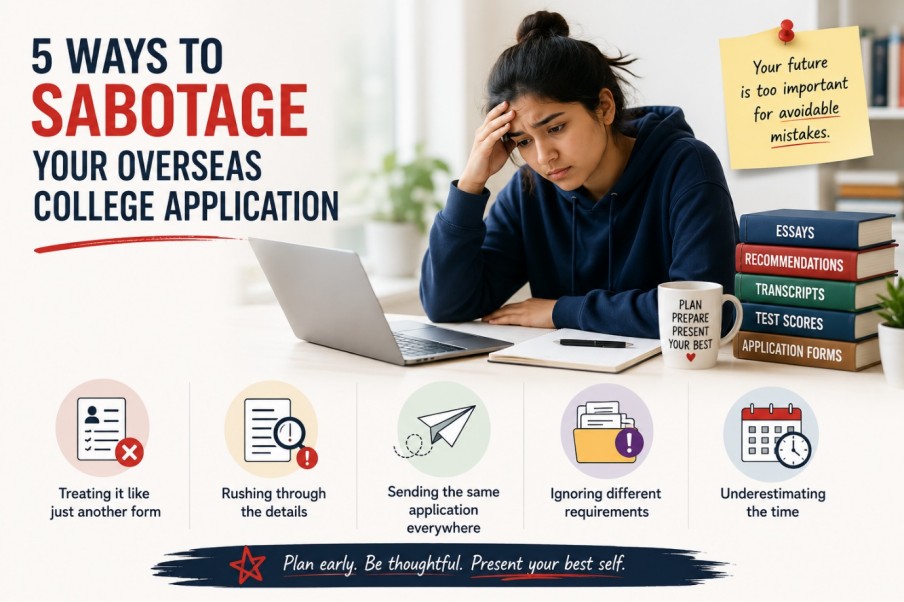
Main heading of the article: 5 ways to Sabotage your Overseas College application (without realising it)
Many parents are surprised when they discover how much work goes into an overseas college application.
After all, college applications in India are usually quite straightforward. You fill in the application form, upload your academic records, pay the application fee, and wait for the results.
Applying to universities overseas is very different.
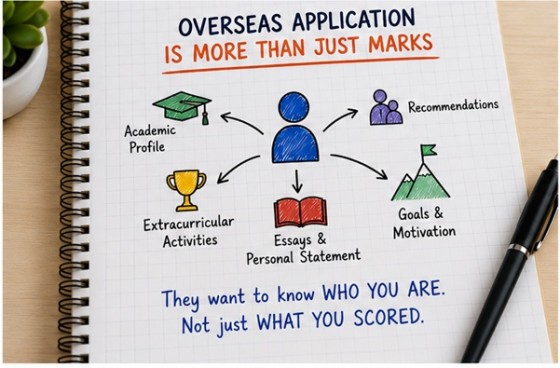
Most universities don’t just want to know how well you scored. They also want to understand who you are. Your interests, achievements, experiences, goals, and the contribution you could make to their campus all become part of the admission decision.

That’s why preparing a strong application isn’t something you do over a weekend. It takes planning, research, and attention to detail.
Unfortunately, many students weaken their applications because they don’t realise this difference.
Here are five common mistakes to avoid.
1. Treating it like just another application form
This is probably the biggest mistake of all.
An overseas application isn’t simply about entering your marks and clicking “Submit.” You’ll often need to write personal essays, describe your extracurricular activities, request recommendation letters, prepare portfolios (for certain courses), and answer university-specific questions.
Students who leave everything until the last minute usually end up submitting applications that don’t reflect their true potential.
2. Rushing through the details
Incorrect grades, spelling mistakes, inconsistent information, or missing achievements may seem like small issues, but they create an impression that the application was prepared carelessly.
Before submitting, review every section carefully. A single mistake may not lead to a rejection, but a carefully checked application always creates a better impression.
3. Sending the same application to every university
Every university has its own culture, strengths, and expectations.
If your essays could be copied and pasted into applications for ten different universities, they’re probably too generic.
Admissions teams want to know why you’ve chosen their university and how you’ll contribute to their community. A personalised application demonstrates genuine interest and makes your application much stronger.
4. Forgetting that every university has different requirements
One university may ask for two recommendation letters. Another may require a portfolio. Some may ask for additional essays, while others may have optional interviews.
Assuming that every university follows the same process can result in incomplete applications or missed opportunities.
Create a separate checklist for every university you’re applying to.
5. Underestimating the time the process takes
Recommendation letters need to be requested well in advance. Essays go through multiple drafts. Parents may need to arrange financial documents. Students often revise their university shortlist as they learn more about different institutions.
The strongest applications are rarely completed in a few days. They’re built over weeks and, in many cases, months.

The bottom line
A successful overseas college application isn’t about presenting a perfect student. It’s about presenting an honest, thoughtful, and well-prepared picture of who you are.
Students often assume that applying overseas is simply a longer version of applying to colleges in India. It isn’t.
It’s a different process with different expectations.
The earlier you understand that, the better your chances of submitting an application that truly represents your potential.
At MindScan, we work with students & handhold them through the entire process of university research and application. If you’re thinking about applying to the best universities in the world, we’ll be happy to partner you on this journey. Connect with us today !