When families think about planning for higher education, the first thought is usually money. “How much will it cost?” “Can we afford it?” “Should we look at options in India or abroad?” These are valid questions.
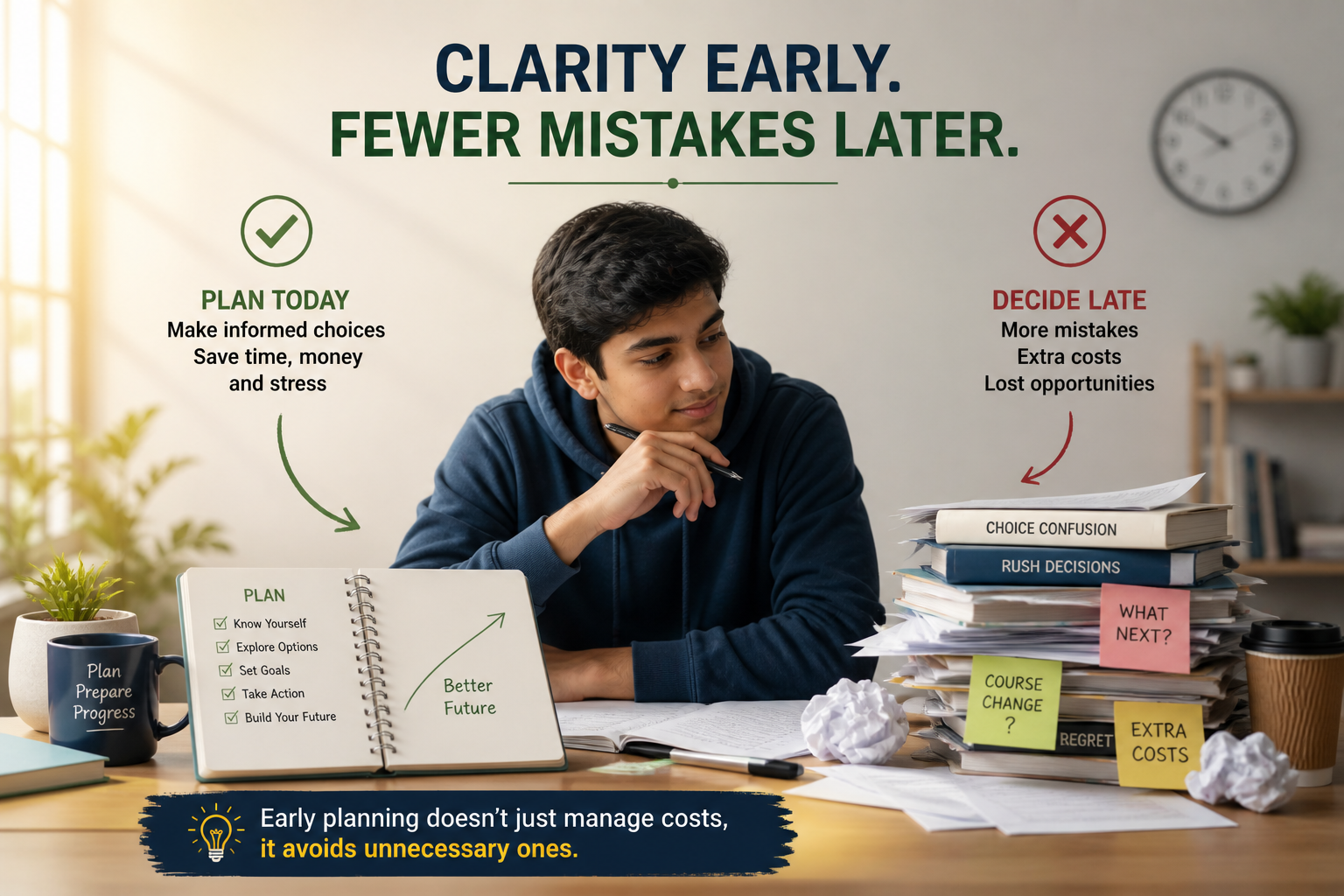
But after working with students and parents for over 15 years, I’ve realised something important: Early planning is not just about managing costs, it’s about avoiding unnecessary ones – the ones that hurt the most.
The hidden cost of late decisions
Let’s take a common situation – a student reaches Class 11 without much clarity. They pick a stream because friends are choosing it, or because it “keeps options open.” Later, when they start exploring courses seriously, they realise the fit isn’t right. Now there are two choices.
- Continue anyway
- Change direction.
Neither feels great – if they continue, motivation drops. If they switch, time and money are already spent. This is where early planning makes a difference.
Different families see this differently
Some parents believe: “Clarity will come with time….why rush?” Others feel: “We should decide early and stay focused.” Teenagers often sit somewhere in between: “I want to explore… but I also don’t want to make the wrong choice.”
All three perspectives are valid. The problem is not any one view. The problem is when there is no structure to guide the process.
What early planning actually saves?
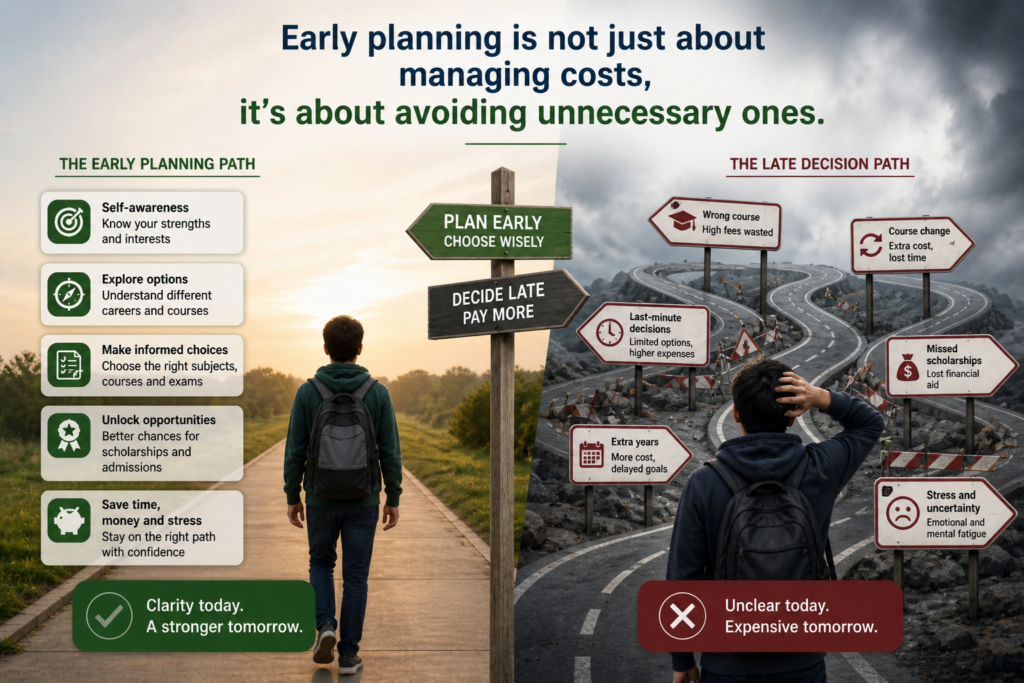
It’s not just about saving on tuition, but rather saving you from situations like:
1. Choosing the wrong course
This is the biggest one. A course that doesn’t match your child’s interests or strengths often leads to disengagement, course changes, or even starting over.
2. Last-minute decisions
When applications are rushed, choices are based on what is available, not what is suitable.
3. Missed scholarship opportunities
Many scholarships depend on consistent effort over time, not last-minute preparation.
4. Incorrect subject choices
The subjects your child chooses in school can open doors or close them. Without planning, options become limited later.
5. Extra years
Switching paths, repeating applications, or correcting earlier decisions all add time and cost.
What early planning is NOT... it is not about deciding a career at 14 and sticking to it forever. That’s unrealistic. It is about starting the process early enough so that:
- Your child understands themselves better
- Options are explored properly
- Decisions are made with awareness, not pressure
A small shift that changes everything. Instead of asking: “What should my child become?” Try asking: “What are we learning about them each year?” This changes the focus from deciding quickly to understanding gradually.
I’ve seen families where early planning made a real difference, because when the time came to decide, they were not starting from zero. They had:
- Clarity on strengths
- Realistic options
- A sense of direction
- Confidence in their choices
And most importantly, fewer surprises.
Final thought : Education is one of the biggest investments a family makes. It is a financial & an emotional decision , where early planning doesn’t remove uncertainty, but it does reduces avoidable mistakes. And over time, that makes a meaningful difference.
At MindScan, we work with students & handhold them through the entire process of university research and application. If you’re thinking about applying to the best universities in the world, we’ll be happy to partner you on this journey. Connect with us today !